
Legends Class
Legends Class is aimed at Old School more full bodies trucks that hit the rocks of Milbrodale from 2001 to 2010.
No tyre size limit
Portal Axles, Rear Steering, Active Suspension are permitted.
Aimed at encouraging past competitors such as Phil Noble Nissan, Bob Watling’s Red Bitch and Wayne Rumbles HiLux back to Tuff Truck.
We are looking for trucks with nearly a full front and side profile back to b pillar With original windscreen and firewall. ( some exceptions may apply upon application)
This class is not for tube frame builds.
You can run portals, 4 wheel Steering and Active Suspension. (Scoring Penalties will apply for Rear Steering)
Tyre size is unlimited but agricultural tractor tyres are not permitted
You can taper the front grille,
To 80% GQ Grille width does not include indicators but add 10mm out side of headlights each side
GU grille is classed as bonnet width,
80 Grille is outside of outer headlight trim,
Hi Lux is outside of headlight + 10mm
We also welcome new builds. If you intend to enter please contact Comp Manager for clarification of all rules to ensure you fit our desired outcome for this class.
Limited Class
Max 42″ Tyre Size
No Rear Steering permitted.
No Portal Axles
No Active Suspension eg.Hydraulic lift, race jackers, or any other form of modification that enables lifting the vehicle
All other rules apply
Unlimited Class
No Changes to current rules.
General Rules & Regulations
Downloads
Jumps
Tuff Truck Site Use Restrictions outside of the Main Event:
All courses/stages are Strictly Prohibited areas. No person is authorised to drive any Tuff Truck course/stage at any time unless:
- Written approval has been give from Tuff Events & Promotions Australia – email: [email protected]
- It is an organised Tuff Truck Social Event ( Staff / Teams & family of teams )
- You are competing in other events hosted at the same property. i.e Milbrodale Mountain Classic or King of the Hunter
The area directly behind the Tuff Truck Site Shed is exempt from the above restrictions. i.e All Terrain Track / Dry creek Bed, Tomahawk etc.
2.2 THE SPIRIT OF THE REGULATIONS
The use of non-natural track building aids such as sand ladders and synthetic matting shall not be permitted in DSP sanctioned events. The use of natural objects or items contained within the stage only is permitted. The use of any items not within the stage prior to starting the stage, or non-natural items or objects, will result in the competitor being awarded a DNF for the stage.
2.3 DSP MEMBERSHIP
Competitors, & their crew participating in DSP sanctioned events shall be current members of DSP. 2021 Memberships open on January 1st 2021.
2.4.1 LICENCES
Each driver and co-driver shall hold a current valid State, Territory or International driver’s licence. Learner’s permits are not acceptable.
2.4.2 CREWS
Crews shall be a maximum of two people in all Stages and be designated as:
- Driver – who only drives the vehicle
- Navigator – who only navigates (either within or from outside of the vehicle)*
2.4.3 CREW SUBSTITUTION*
Alternating between driver and navigator for any stage of the event shall not be permitted without the permission of the Competition Manager. If you wish to alternate to share driving experience this is allowed but must be approved by the Competition Managers.
Any substitute team member, i.e. (driver or navigator) must be a DSP financial member. DSP memberships will be available from Competition Managers if required.
Any crew which includes a person not identified to and approved by the Competition Manager shall be disqualified.
2.4.4 CODE OF CONDUCT
At all times competitors and event officials shall treat all participants in a courteous and respectful manner.
Competitors shall avoid public argument with each other and officials and all disputes shall be dealt with under the provision for protests in the sporting regulations. Verbal or physical abuse by any participant shall attract a penalty. Any competitor or participant who is found guilty of a serious breach of the code of conduct will be disqualified from further participation in the event with no refunds.
2.4.5 ABUSE OF ALCOHOL OR DRUGS
The abuse of alcohol or drugs by competitors or event officials at any time during an event shall not be permitted. Medication prescribed for a competitor by a doctor shall be accepted, provided such medication does not affect that competitor’s safe performance during the event. Prescribed medication shall only be taken by the competitor for whom it is prescribed.
Alcohol shall not be consumed prior to or during, any competition stages, or before departing for, or during, any transport stages.
Breathalysers may be used to check blood alcohol content during the event. Those competitors or officials who register any reading above zero shall not participate or officiate for the remainder of that day. Any competitor or official who refuses to provide a breathalyser reading shall be disqualified from further participation in the event.
The use of any other drugs shall be prohibited at all times during the event. Any competitor found to have used any other drugs shall be disqualified from all further participation in the event. Any official found to have used any other drugs shall be immediately removed from their capacity, and restricted from acting in any official role for the remainder of the event.
Any event official or competitor who suspects another event official or competitor to be under the influence of drugs or alcohol shall refer the matter immediately to the Event Director.
2.5 SELECTION
Selection of competitors shall be determined by Tuff Events & Promotions Australia (TEPA)
Tasks that will increase your chances of being selected:
- Send your nominations in Early
- Ensure your vehicle is ready for Pre-Verification
Up to 5 Spots may be left available to TEPA to use as Wild Card entries.
If your team is unsuccessful and not selected, a full refund of all monies paid will be made.
2.6 VEHICLES
A high standard of presentation shall be insisted upon at all times. Any vehicle considered to be of an inappropriate standard of preparation may not be permitted to start, at the discretion of the Competition Manager. A vehicle that is accepted by the Chief Scrutineer shall not be substituted.
2.7 ADVERTISING AND DECALS.
Each vehicle may display Crew sponsorship material provided it is not, in the sole opinion of the Competition Manager or Event Director, offensive and does not intrude into the space allocated for event sponsorship/advertising.
TEPA Event sponsorship/advertising allocated space shall be
- The entire bonnet area must be free from all previous stickers / decals
- An area of 450 x 300mm on each side profile forward of the B-Pillar. 23/4/2016
Additional event sponsor decals typically small in size may be placed at any suitable location on the body of the vehicle but shall be clearly visible.
3.6.1 OCCUPANT RESTRAINTS* Updated Feb 2016
Harnesses shall be properly fitted, correctly fastened and adjusted during all stages whilst the vehicle is in motion. No member of the crew shall ride on the outside of a competing vehicle and no member of the crew inside the competing vehicle shall have any limbs outside the vehicle whilst the vehicle is in motion. The harnesses may be partially released but only from one shoulder when the driver is required to reverse to ensure better visibility. The harness must be re-fastened prior to the forward movement of the vehicle.
All Motorsport Harnesses have a manufactured date (SFI) stitched in up to 3 positions on each harness. Harness validity for is 3 years from SFI Date. This is a major safety concern and must be adhered to.
All harness must have a Taxi Bar fitted behind the drivers & navigators seats.
3.6.2 CRASH HELMETS
The wearing of crash helmets is compulsory. All helmets will be checked and required to have the AS1698 label stitched inside the helmet. ( other governing approvals will be considered on an individual basis, Please advise us prior to the event )
3.10.2 WINCHING
Due to the close proximity of spectators, Vehicle Progression Winching on a stage is NOT PERMITTED. ( supervised recovery & diff winches are permitted uses )
3.21 PERMITTED REPAIRS & SERVICING
Any form of repair / servicing of competitors vehicle is permitted, with the only restriction being that the vehicle may not at any time leave the site. The intention is to ensure that competitor’s vehicles, if damaged, are repaired quickly and safely, and are able to continue the competition. Major vehicle works can only be carried out in your designated work bays. ( children under 16 are not permitted in these areas )
4.1.2 VEHICLE REGISTRATION
Vehicle registration is Not Required or in anyway used to determine vehicle safety.
4.1.3 OCCUPANT CLOTHING
All competitors must wear the following attire.
- Enclosed shoes
- Long pants, No shorts are permitted.
- Navigator must wear enclosed gloves at all times whilst competing on a stage ( excluding mechanical repairs )
- If Drivers are outside of the vehicle, they must also wear enclosed gloves ( excluding mechanical repairs )
ROLL OVER PROTECTION
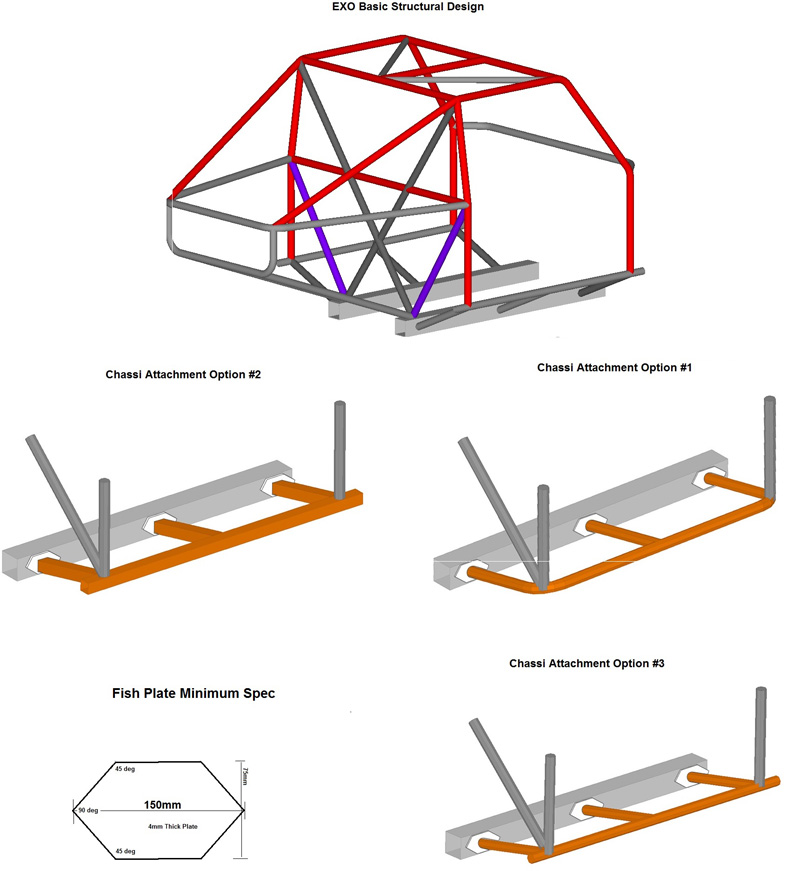
EXO ( External of Body work ) Cages: .. Any teams with material compliant exo cages will be assessed upon application.
If you are a team that previously had an EXO cage made out of non compliant material, you can leave your existing EXO & add a compliant 4 point internal,
However this exemption is not allowed without written approval from TT.
You must make written ( email ) contact with Tony Price to confirm that your plans are accepted. Phone calls will not be accepted as evidence of approval.
Exo cages and their attachment points: minimum spec material to us is 1-3/4″ (44.45mm) / 350 MPA 0.102″/2.6mm wall thickness for tube OR 50x50x3mm square RHS.
Min 2.5mm Wall Thickness 2.0″ 50.8mm or 1.75″(44.45mm OD) Tube must be used for the b-pillar hoop, if the A&B Pillar are one piece, they must also be 1.75″. Including the cross Horizontal brace in the roof that joins the A to A & B to B-Pillar ( from left to right side of vehicle ) All other associated bracing is to be a minimum of 1.5″ OD 38.1mm / 2.5mm min wall thickness tube. ( 1-3/4 or 2.0″ recommended )
For all teams building new vehicles, we strongly recommend that your build your entire cage using 1-3/4″ throughout the entire construction @ a wall thickness on 0.120 / 3mm
THESE PIPE Sizes are NOT allowed. i.e 33.4mm OD / 42.2mm OD / – Commonly known as Nominal Bore – 25Nb / 32NB / Black Pipe.
40NB Pipe 48.3mm OD is allowed if tensile strength is greater than 350MPA & a specification sheet can be supplied as evidence. (i.e Invoice & Specs )
Mounting plate size and thickness, as with pipe diameter, type and wall thickness along with mounting hardware should reflect the vehicle mass.
Existing Competitors will not require an internal cage if your external ( Exo ) cage is up to spec. ( written approval must be requested )
Glass Sunroofs are not permitted and will be removed on any vehicle competing.
All vehicles shall have roof protection installed to protect the crew from intrusions. Roof protection shall consist of a 3mm minimum thickness aluminium sheet or 2mm minimum thickness steel plate or high impact plastic roof panel extending the full width of the vehicle from the windscreen frame to the rollover protection and shall terminate behind the heads of the crew. Perforated mesh is not an acceptable material.
Further design clarifications can be requested from competition manager and is highly advised to ensure your cage is designed adequately.
NOTE: If you are building a new vehicle for Tuff Truck Only, then the above specifications are your guidelines which are basically the same as 2017. ( minor clarifications have been amended only )
If you are planning an entirely new build for Tuff Truck 2018 & are planning on using the same vehicle in ULTRA4 Style events, ( combo vehicle ) you MUST build them to the ULTRA4 Specification. https://ultra4racing.com.au/racers/rules/ –
4.1.5 RECOVERY POINTS
Two Recovery points shall be mounted at the front and two at the rear of the vehicle chassis with at least two of 12mm or four of 10mm grade 5 or M8.8 bolts. Recovery points must be painted red. Eyebolts are not considered as satisfactory recovery points. We require a point in line with or outside of the chassis rails. We require the points to be constructed from 10mm x 75mm plate or larger. Each point should be capable of accepting a 4.7 T rated shackle. These should be designed and fitted in such a manner that the shackle can accept a vertical recovery lift. Eg: The shackle should be able to move in a 90 degree arc from horizontal to vertical. If you are unsure of our requirements please contact the Competition Managers.
Monocoque frame vehicles shall have each recovery point mounted such that the load is applied evenly to the vehicle frame, or have recovery points linked to achieve even load application. Must be approved prior to event.
4.1.11 SPARE WHEELS
The changing of spare tyres due to a puncture or flat during a stage is prohibited.
Spare wheels are no longer compulsory, however it is recommended you have one in the event of a tyre failure so you can continue to compete.
All vehicles must meet the following DESIGN requirements to be eligible for entry: REMOVED December 20th 2017
The vehicle originally started its life or was designed and/or manufactured by the maker as a 4WD or 6WD vehicleREMOVED December 20th 2017Retains the look of the original 4WD vehicle, comprising 80% of the original front profile including, Grille, Headlights & Windscreen and 50% of the original side profile from & including the “B-pillar” forward.REMOVED December 20th 2017
4.2 – CHASSIS RULES – Updated December 20th 2017
- 4.2.1 – The chassis used on the vehicle must be from a vehicle that was originally designed and/or manufactured as a 4WD or 6WD with a transfer case consisting of both low and high range.
- 4.2.2 – Legitimate Re-Constructed Chassis that are offered to the public for purchase and are Register-able in Australia Are Permissible.
- 4.2.3 – “The Gospel according to Tuff Truck” Home made, one off or even 20 off re-produced chassis are ARE NOT PERMISSIBLE.
- 4.2.4 – The Chassis Used Must Be One that has been offered to the General Public for Purchase. ( Vehicle Chassis that were not intended for public supply are not permissible )
- 4.2.5 – The Clear Objective of Building a Tuff Truck Compliant Vehicle is to Build the Vehicle around the Basis of the selected Chassis.
- 4.2.6 – We do not want to see and will not allow a rock crawling buggy or like that has been Re-Designed and just added a Chassis in attempt to comply.
- 4.2.7 – The Chassis Used MUST be located in a normal position under the floor pan of the vehicle. ( not on the roof )
- 4.2.8 – The “Front” of the Chassis must start at least 300 mm forward of the original firewall position ( ie. vertical section where brake master & booster mounts )
- 4.2.9 – The Chassis Must Finish “behind” the B pillar on a 2 door vehicle and behind the C pillar on a 4 door vehicle.
4.2.10 – The majority of vehicles are re-locating their original B-Pillar’s, Therefore the Chassis MUST Finish behind the re-manufactured roll cage B-Pillar. - 4.2.10.a – i.e Seat in most rearward position at the back of the headrest, vertically down is where we want the Chassis to end.
- 4.2.11 – The vehicle chassis must remain 100% original in height, width and profile as viewed looking directly at the originating vehicle, ie Top, side & front view.
- 4.2.12 – The chassis must also retain original parallel spacing. ( ie. centre to centre width )
Note: These chassis rules above have been carefully considered and based around current and previous competing vehicles. However if some of the past vehicles are slightly outside of these guidelines, we have made the conclusion that these vehicles have no competitive advantage and will be accepted.
Any past competitor that is undergoing major chassis alterations must comply with the ruling above.
If you are uncertain regarding compliance of this rule you must contact TEPA for further clarification. TEPA holds no responsibility for competitor’s mis-interpretation of this rule.
TUFF EVENTS & PROMOTIONS AUSTRALIA RESERVES THE RIGHT TO ACCEPT OR REJECT ANY NOMINATED TEAM!
- 4.2.13 – Monocoque chassis vehicles will be assessed on application.
4.3 – ENGINE Positioning
- 4.3.1 All vehicles are to have the engine fitted to the front of the vehicle. The following measurements must be adhered to. The front face of the engine block is to be no further rearward measuring from the centre of the front axle tube. For V6 engines 500mm) for V8 & straight 4 cylinder engines, (450mm), for Straight 6 cylinder engines (350mm). Again previous competitors that may be slightly outside this will be accepted. Research thus far states that there is currently no teams outside of these guidelines.
4.4 – BODY REQUIREMENTS.
- 4.4.1 – The body used on the vehicle must be from a vehicle that was originally designed and/or manufactured as a 4WD or 6WD with a transfer case consisting of both low and high range . NOTE: We will consider the use of alternate bodies that don’t apply to this rule upon “application only”. ie: Rav 4.
- 4.4.2 – The Body used must have been available for purchase by the general public.
- 4.4.3 – Re-made body panels are acceptable, so long as they are “IDENTICAL” in profile as the originating body used. All shape and folds must be duplicated as original.
- 4.4.4 – Body / Chassis swaps are permitted. Eg; Suzuki body on Nissan chassis. Their associated normal firewall position must line up with the firewall position of chassis used.
- 4.4.5 – The vehicles body width must remain at its original width at the A-Pillar relative to the body used. i.e. Cannot be narrowed. B-Pillar must also be at least A-Pillar width.
- 4.4.6 – The Firewall must fully separate the Driver & navigator from the engine compartment with a minimum of 2mm Aluminium, ( 1.2mm on existing vehicles ) or an alternate fireproof material which will accessed by TEPA. Original firewalls are acceptable, gaps for additional vision will not be acceptable. Perforated mesh is not an acceptable material.
- 4.4.7 – Floor Area: The area from the B-Pillar forward to the area directly in front of the pedal assembly must be manufactured out of a minimum of 2mm Aluminum & must meet the firewall in order to give occupants protection from hot or high pressure fluids in the event of any failure.
- 4.4.8 – The Original floor of the body used is acceptable. Perforated mesh is not an acceptable material.
- 4.4.9 – TEPA holds no responsibility for miss-interpretation of the building guidelines, whilst we do our best to clarify each rule there may be ways each person reads them. It is highly suggested that any competitor planning to build a vehicle for TTC, then you should contact Competition Managers Tony Price to discuss specifically your intentions.
TUFF EVENTS & PROMOTIONS AUSTRALIA RESERVES THE RIGHT TO ACCEPT OR REJECT ANY NOMINATED TEAM!
Front Vehicle Profile
Original Grill / headlight surround must be 80% of original size. eg. if yours is factory width 1000mm, then you can only re-size down to 800mm. if yours is 1200mm, then your minimum size is now 960mm. Inclusive of Headlights. Examples of Applicable Vehicle Types – FJ40/45/47, Jeep CJ/TJ/JK, Suzuki Sierra etc…
For vehicles that have a full width front end, i.e 60/80/100 Series Land Cruiser, Nissan Patrol GQ/GU you must retain 70% of the original front profile “Grill & Headlight surround Section”. Note: If the grill is 1000mm wide, the narrowest you could take it is 700mm.
You must retain your Original Headlight Glass surround. NO Spot lights or LED’s will be allowed.
Spot lights or led lights are permitted inside the original headlight glass if achievable.
Headlight modifications are allowed, but must use the original headlight glass. You must Contact TEPA for approval prior to modifying!
Always seek clarification from TEPA prior to modifying these crucial areas of your vehicle.
Tail/Brake & Indicators Lights
Indicators are no longer required.
Tail Light / Brake Light combos must be a minimum size… options are: 150mm L x 45mm H / 90x90mm Square / 100mm Round.
If are just outside of this sizing, send us an email & we will advise if its acceptable. [email protected]
Competitor Nominations – The Competition Managers reserves the right to accept or decline any nomination received.
Handbrake – All vehicle require a hand brake, mechanical or electric solenoid are acceptable. ( auto park position is NOT accepted )
Coverage over wheels – Not applicable
This is not an open ticket to take guards completely off vehicles. Basically we want to remove the ( Dumbo Ear ) type guards that look terrible.
However, you must retain the quarter-panel area below the rear of your bonnet so that it’s not entirely an open area from your a-pillar to your arch. We’d still like it to look like a vehicle in this area from side on.
Bonnets may be clearanced to allow for tyre articulation. They must not be narrower than standard at the rear of the bonnet (where the bonnet meets the base of the windscreen) & are allowed to taper in to no narrower than your allowable grill width.
Seek clarification with competition manager if you are uncertain.
Windscreens – With the nature of this event windscreens are compulsory. Windscreens must retain 95% of original size of body shape used, Lexan is an approved alternative, Mounting must be in an “original frame”, or replicated copy. ( ie. fibreglass ) No exceptions.
There are couple of vehicles that may be slightly outside this change which will be accepted as previous competitor leniency. ( also deemed no competitive advantage )
Wipers & washers: All teams must have wipers and washers. They can not be manually operated.
Window Nets – Are required to be fitted to the drivers and passengers window aperture. The nets must cover at least 70% of the opening and be readily opened from the top from inside and outside the vehicle. The nets may be of the string variety with mesh size no greater than 50mm x 50mm.
There is to be no gap between the bottom of the window net & the top of the door.
Cable ties and Electrical or gaffer tape will not be accepted.
Our aim is to keep arms and shoulders within the cabin should the doors open in the event of a rollover.
Doors – MUST OPEN & CLOSE *** UNLESS*** your vehicle is fitted with satisfactory A to B Pillar intrusion bars. All vehicles must be fitted with, at least, half doors from the sill up. Again the reason behind this is increased occupant safety against intrusion, and also to permit sponsorship sticker placement. The basis for construction of these will be at least steel, aluminium or of equivalent strength or greater. If using non original door panels, they must replicate the original shape & profile of the body type used ( same door skin profile, folds etc ). Plastic will not be accepted.
There are couple of vehicles that may be slightly outside this change which will be accepted as previous competitor leniency.
Steering and Four Wheel Steering Systems – Vehicles shall be allowed to have hydraulic assist or full hydraulic steering system, however 4 wheel steer vehicles will have a penalty applied if used during a stage.
Automatic Nomination – The first four place finishers from the previous Tough Dog Tuff Truck Challenge will automatically receive selection (if desired), into the next event.
Rule Changes & Amendments – The event organisers reserve the right to make changes or amendments to the rules at any time prior to commencement of the event.
TUFF EVENTS & PROMOTIONS AUSTRALIA RESERVES THE RIGHT TO ACCEPT OR REJECT ANY NOMINATED TEAM!
Verification
Verification (was previously known as Scrutineering) carries points totaling 100. Please take the time to look closely at the detail relating to Verification, as it will be in any teams favour to obtain maximum points.
Please make sure that the below sheets are used as a check list in the lead up to the event.
Verification will be open on site at 12pm Thursday 27th April till Midnight.
If a team member is unavailable ( eg Thursday ) but one team member & vehicle is ready to go. Please proceed to verification & when the second team member does arrive, he or she can then see the verification team without penalty.
The following verification points are available as a PDF for download.
Verification is compulsory. Any team that does not attend will not start!!
Pre-Verification
Electronic Pre Competition verification is compulsory. The date for information received will be no later than 28th Feb 2023. We will require detailed photographs of a list of items that will be provided upon entry. All vehicles must show that they are able to be driven. Our aim here is to ensure that all teams vehicles are prepared & ready for the event. TEPA reserves the right to accept or decline any nomination received.
Pre-Verification (PV) is a compulsory aspect of TTC to assist all competing teams in their vehicle preparation. The rules and regulations (along with supplementary) are required to be adhered to and by providing compulsory pre-verification, this will assist teams in complying.
PV will assist competing teams in achieving:
- Meeting satisfactory standards of vehicle Rules and Regulations
- Answer any queries that might be had
- Foster good relations with fellow competitors and event organisers
For any queries on PV (or any other aspect), please contact Tony Price (Competition Manager)